Railway product guide

The Cyber Resilience Act in rail

An onboard Ethernet switch can spend years in service after its first EU sale. What must its manufacturer demonstrate before release, and what happens when a supplier reports a vulnerability five years later?

Follow the switch through the CRA ↓
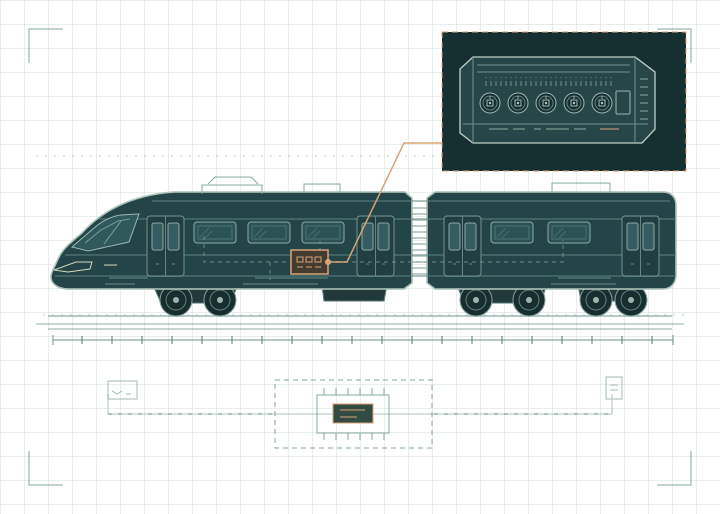
Side elevation of a passenger train. A copper line connects the highlighted onboard Ethernet switch to an enlarged view of its enclosure and connectors. A dashed box identifies the firmware.
Illustrative train network. The switch and its firmware form the example supplier’s product boundary.

Product scope & responsibilities

EU market access

Start with what the customer buys. In this example, a supplier sells a managed onboard switch under its own name. Its firmware and management interface are part of the product being assessed.

The CRA covers hardware and software made available on the EU market whose intended or reasonably foreseeable use includes a direct or indirect data connection to a device or network. A closed train network can qualify. Check exclusions and the role of each economic operator for the actual supply arrangement.

CRA · the product

The manufacturer is responsible for the switch’s security and conformity. A business supplying a product under its own name or substantially modifying it can take on manufacturer obligations.

NIS2 · the organisation

A railway undertaking or infrastructure manager may have duties for operational resilience and supplier risk under national law. A tender may therefore ask about incident contacts or continuity. A contract alone does not determine the supplier’s own NIS2 status.

CRA Articles 2, 3 and 21 · NIS2 scope and national implementation

Conformity assessment

Technical documentation and CE marking

Suppose an unauthorised configuration change could interrupt onboard communications. The technical file should explain why that matters, how the switch limits it and what evidence supports the claim for the firmware being shipped.

One risk traced through a managed switch release
  1. Operating contextMaintenance staff configure the switch in the depot.
  2. Security decisionOnly authorised roles may change the network configuration.
  3. VerificationA dated check records whether a read-only user can alter settings.
  4. Release evidenceThe technical file links the result to the firmware version and remaining limitations.
Where the work falls in a railway product programme
WorkstreamDesignReleaseIn service
Risk assessmentModelVerifyRevisit
Technical fileBuildBaselineUpdate
Security supportPlanPublish termsMaintain

Illustrative workstreams for one switch family. A new firmware version can send a change back through risk review and verification.

Decisions behind the CE marking

What does Annex I require?

Part I addresses product security. For the switch, relevant choices might include secure defaults, access control, availability and secure updates. Part II addresses how the manufacturer handles vulnerabilities. Record how the risk assessment informs the applicable requirements, including the reasons for any requirement judged inapplicable.

When does the assessment route change?

Annex III lists switches in Class I. The implementing regulation describes switches that forward packets and have a management plane. Compare the marketed product’s core functionality with that description. An Ethernet port alone cannot settle the classification.

For a Class I product, using internal control depends on full coverage through the means specified in Article 32. Where those conditions are unmet, the relevant requirements need an external assessment route. A rail safety approval answers a separate question.

EU technical descriptions of product categories
What goes into the release decision?

The technical documentation identifies the product, design, risk assessment, applicable requirements and verification results. Once the applicable conformity procedure is complete and conformity demonstrated, the manufacturer draws up the EU declaration of conformity and affixes the CE marking. Authorities can require corrections and, where warranted, restrict supply, withdraw products or order a recall.

CRA Articles 13, 28–32 and 54 · Annexes I, III and VII

In-service support

Vulnerability handling and security updates

A supplier advisory names a software component. The fleet operator knows the installed switch model. Connecting those two facts requires a record of what shipped in each firmware release.

Component evidence
A machine-readable software bill of materials (SBOM) covering at least top-level dependencies helps identify potentially affected releases. A match starts an impact assessment.
Security support
The manufacturer sets a support period reflecting expected use. The general minimum is five years. If expected use is shorter, the period corresponds to that lifetime. Long-lived railway equipment needs a rationale grounded in its service conditions.
Fleet deployment
The manufacturer handles vulnerabilities and provides security updates through the support period. The operator may schedule installation around maintenance windows. Clear version information and deployment instructions connect these responsibilities.

CRA Article 13 and Annex I, Part II

Reporting obligations

CRA Article 14

For a manufacturer, the clock begins on awareness of an actively exploited vulnerability in the product or a severe incident affecting its security. A supplier notice alone does not establish either trigger.

  1. 24 hoursEarly warningNotify without undue delay and within 24 hours of awareness through the Single Reporting Platform.
  2. 72 hoursVulnerability or incident notificationMeasured from awareness, including the information required for the event unless already provided.
  3. Final reportTwo different deadlinesActively exploited vulnerabilityWithin 14 days after a corrective or mitigating measure becomes available.Severe incidentWithin one month after the incident notification.

Manufacturers also inform impacted users, and where appropriate all users, about the event and measures they can take.

Commission guidance on CRA reporting

CRA application dates

Transition for existing products

  1. Chapter IV began applying to the notification of conformity assessment bodies, subject to the Article 35(1) exception.

  2. Article 14 manufacturer reporting began, including for in-scope products already on the EU market.

  3. The main product and conformity obligations apply. For a fleet order spanning this date, establish when each unit is first placed on the EU market.

What about an existing switch model?

For a unit placed on the market before 11 December 2027, the main requirements generally apply only if it undergoes a substantial modification from that date. A later unit of the same model can have a different placement date. Assess the effect of any change on intended purpose or conformity.

CRA Articles 69 and 71

Regulatory updates

· European Commission

First European standard supporting the CRA

The Commission announced the publication of a standard covering general cybersecurity principles across the product lifecycle. Railway suppliers can use those principles to organise design and support evidence. Check the Official Journal before relying on a standard for any presumption of conformity.

Read the Commission update

· ENISA

Single Reporting Platform launches

ENISA launched the platform for mandatory CRA reports. Railway manufacturers can use this milestone to confirm who will assess a reportable event, prepare the notification and submit it within the applicable deadline.

Read the ENISA announcement